Overall, I've found this project quite enjoyable yet difficult, mainly due to the struggle I've had with the script and creating a decent idea that invokes the desired feelings and thoughts within the viewer but still being sensitive myself so as not to add to the sexism that I'm highlighting. I'm happy with where the idea has ended up, having come all the way from a step-by-step representation of the Heroine's Journey, but recognise that I need to work some more to reintroduce that sense of conflict within the story that has been dropped over time. I'm also unsure that the deeper meanings behind the scenes (woman as carer, woman as prisoner, etc) are recognisable to viewers who have no prior knowledge of my project and what I'm attempting to convey.
I'm pleased with the direction the art took over the course of the project as I applied a lot more colour than I usually do and had a rougher style as opposed to my usual which is generally far more neat and controlled. At times though, I do think the storyboards and animatic can be hard to read as there is a lack of definition in the characters and scenery that could have been reached had I given myself more time to draw everything out as I did for the background of the Mulan exterior scene which looked much better-rendered than any of the other scenes. On top of editing the script, I have to design more concepts for props used in the animation as, so far, there are no concepts or turnarounds for the boat, bow, quiver, hook or cars - all of which will be needing proper designs to be taken forward into Maya.
While I have enjoyed the process of creating this animation, I am unsure whether it's something I'll want to continue through to Year 3. As I hope to work as a 3D character modeller after graduating from University, I think it may be more beneficial to design, model and rig a character to a professional standard which can then be used to apply for work. I'm still unsure of this so I'll be discussing this idea further in the future.
Ethel and Ernest (2016) is a British-made 2D animation directed by Roger Mainwood and is based on the graphic novel 'Ethel and Ernest: A True Story' written by Raymond Briggs. The love story follows a young man, Ernest, and Ethel, a young maid, from their meeting all the way through to their eventual deaths. The novel is based on Briggs' own parents, telling their story as he was told by them. The couple aren't remarkable or outstanding in any way - the "ordinariness of this relationship, though, is just what makes it special" (Robey, 2016).The film is generally very heartwarming as the viewer is allowed to watch the budding love of the couple and the ups and downs of their relationship, through childbirth and the second world war. However, because it is a true story set during a challenging time in British history, the film can be rather challenging at times, which is especially true when the married couple eventually dies after having become attached to them throughout the film.
Throughout the film it is clear that Briggs had a great love and admiration for his parents - the story being lovingly told throughout with a "considerable nostalgic charm to the low-key tale" (Harvey, 2017). Cloth Cat Animation, the studio responsible for bringing the animation to life, is a British animation studio most well-known for their 2D animations. While Ethel and Ernest is a bit of a departure from their usual work, as they generally focus on children's television programmes, the soft and romanticised art style used works to the advantage of the animation, giving it a childlike, almost reminiscent charm. It is perhaps this charm that led to the books' great reception from both the general public and critics alike, becoming a bestseller. The animated film didn't quite have the same impact on the British public, despite it telling the story in an arguably more mainstream medium. The production team was rather small and the film was only showed in the UK, but the intake of $111,385 is still much less than expected for such a great movie. Bibliography - Harvey, D. (2017) 'Film Review: 'Ethel and Ernest'', Variety: http://variety.com/2017/film/reviews/ethel-and-ernest-review-1202643201/ Robey, T. (2016) 'Ethel and Ernest Review: Raymond Briggs Honours his Parents with Slow-Drip Poignancy', Telegraph: https://www.telegraph.co.uk/films/0/ethel--ernest-review-raymond-briggs-honors-his-parents-with-slow/
Illustration List -
[1] 'Ethel and Ernest', Square Chapel:
https://www.squarechapel.co.uk/whats-on/ethel-ernest/
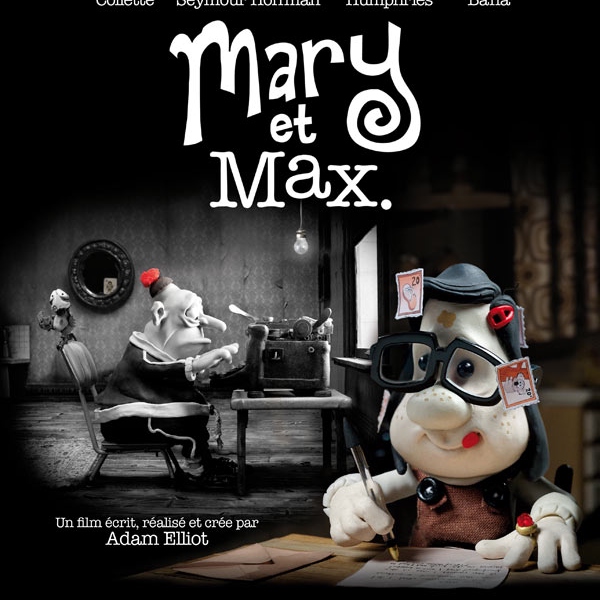
Mary and Max (2009), directed by Adam Elliot is an Australian comedic stop-motion animation. The film features the rollercoaster friendship of a young Australian girl, Mary, and an elderly American, Max. One day at a post office in her home town in Australia, Mary finds an American phone book and decides to write to someone - Max. Over time, a friendship forms between the two, advice is given and gifts are exchanged, until Mary writes her University essay on Max's life, to which he takes great offence. This results in the two falling out until, eventually, Mary decides to fly out to America to visit Max with her infant child. Upon entering Max's apartment, Mary finds Max dead on his couch, staring up at the ceiling. She sits next to him, gazes where he was looking, and realises that his ceiling is full of the letter she had sent to him.
The film was directed by Adam Elliot, a successful Australian director, well-known for his movies featuring a general bitter-sweet quality. The studio responsible for the amazing stop-motion animation is Melodrama Pictures, again based in Australia. The film generally has a gloomy feel to it, with Max's scenes being almost entirely shot in greyscale, and the characters having been "sculpted with bulging eyes, wobbly lines and clumpy figures, Elliot's characters look haunted but cute" (Buckmaster, 2014), giving the entire animation a very unique aesthetic. This 'haunted but cute' feeling is exaggerated and helped along by the use of claymation - the rough-around-the-edges movements and textures aiding the art of the film.
[2]
The movie was very well-received by moviegoers and critics, and rightly so. While story features topics that can be considered quite taboo and hard to deal with, however the comedy and general heartfelt moments throughout the film make it a great viewing experience, with those difficult topics actually aiding this, with the "serious sadness underpinning his vision only [making] the humour work better" (Robey, 2010). While the film isn't quite as well known as it should be, it did manage to make approximately $1.7 billion and has been featured in multiple film festivals, even having opened the 2009 Sundance Film Festival.
Bibliography -
Buckmaster, L. (2014) 'Mary and Max: Rewatching Classic Australian Films', The Guardian:
Paprika (2006), directed by Satoshi Kon, is a Japanese science-fiction anime film revolving around the titular character Paprika, also known as Dr. Atsuko Chiba. Chiba, along with her scientist colleagues, are working on a medical device called the DC Mini - the device is created to help those with psychiatric issues by entering their dreams in an attempt to heal them from within, but in doing so also has the power to damage the mind. So, when one is stolen, Chiba and her team set out to find it before damage is done.
Generally, the film is quite hard to follow with its bizarre twists and turns and exaggerated characters, but this confusion in many ways adds to the experience that the film produces, causing the feeling that the viewers own confusion and bewilderment of the world is in some ways reminiscent of those with psychological problems - the people the scientists in Paprika were supposed to be helping.
The film is based on Yasutaka Tsutsui's novel of the same name, animated by the Japanese studio Madhouse and was directed by the late Satoshi Kon. Kon is very well-known in Japan for his otherworldly projects, taking a special interest in the human mind. Japanese animation is generally known around the world for being very experimental and strange, but even so Kon is "renowned for being particularly weird and experimental" (Naylor, 2008).
[2]
Paprika is "fluidly rendered in both hand-drawn and 3-D animation" (Dargis, 2007), following the usual conventions of Japanese animation. This art style lends itself very well to the exaggerated themes of the film as the characters and scenarios would be hard to replicate in other mediums such as full 3D animation or claymation, especially the countless transitions. The film is filled with strange characters and goings-on that would have been very expensive and time-consuming to create in anything other than 2D - the parade being a perfect example of this. On top of this, Paprika can sometimes put cell-shaded characters next to well-rendered objects and backgrounds which adds to the uneasiness of the film, creating a confusing yet enthralling viewing experience. It was most likely because of this that the film was a huge success, both in and outside of Japan, raking in approximately $944,915 and receiving raving reviews from both the mainstream media and casual viewers alike.
Bibliography -
Dargis, M. (2007) 'In a Crowded Anime Dreamscape, a Mysterious Pixie', New York Times:
Scene 1 demonstrates the expectation to have children, with the act of sailing away being representative of a woman's freedom of choice.
Scene 2 - Katniss - Woman as Prisoner
This scene is used to show how women can often be expected to become housewives, with their homes almost acting as a prison - or a dome.
the frantic attempts at escape in the beginning demonstrate how some women can almost be subdued into becoming what is expected of them.
Scene 3 - Mulan - Woman as Property
This scene portrays the expectation women face to get married and how they are essentially handed from one man (their father) to the control of another (their husband).
The transformation into Mulan represents how women are capable of leading men.
Scene 4 - Furiosa - Objectification of Women
This scene portrays how men can objectify women, while the endless desert is representing the way this objectification can cause a feeling of isolation or separation.
Scene 5 - Ripley - Woman as Mother
In this scene, the Alien queen is used as an embodiment of the pressure women face to have children, while the protagonists destruction being representative of the anger felt towards these outdated expectations.
Bibliography - Slick, J. (2018) What is 3D Modeling? [online] LifeWire. Available at: https://www.lifewire.com/what-is-3d-modeling-2164 (accessed on 08.05.2018) Illustration List - Woody and Buzz [Screenshot] At: https://www.buzzfeed.com/lovefromcrystal/can-you-identify-the-toy-story-movie-from-these-sc-1oqzj?utm_term=.vjQnGAMNRe#.yuVVOk09xE (accessed on 08.05.2018) Jake and Neytiri [Screenshot] At: https://www.independent.co.uk/arts-entertainment/films/news/avatar-2-james-cameron-sequels-release-date-trailer-underwater-scenes-motion-capture-a8068791.html (accessed on 08.05.2018) (n.d) [Render] At: https://www.pinterest.co.uk/pin/294071050663395259/ (accessed on 08.05.2018)
Scene 1 demonstrates the expectation to have children, with the act of sailing away being representative of a woman's freedom of choice.
Scene 2 - Katniss - Woman as Prisoner
This scene is used to show how women can often be expected to become housewives, with their homes almost acting as a prison - or a dome.
the frantic attempts at escape in the beginning demonstrate how some women can almost be subdued into becoming what is expected of them.
Scene 3 - Mulan - Woman as Property
This scene portrays the expectation women face to get married and how they are essentially handed from one man (their father) to the control of another (their husband).
The transformation into Mulan represents how women are capable of leading men.
Scene 4 - Furiosa - Objectification of Women
This scene portrays how men can objectify women, while the endless desert is representing the way this objectification can cause a feeling of isolation or separation.
Scene 5 - Ripley - Woman as Mother
In this scene, the Alien queen is used as an embodiment of the pressure women face to have children, while the protagonists destruction being representative of the anger felt towards these outdated expectations.