Powered by Blogger.

Pages

  • Home
  • Year One
  • Year Two

Translate

Michael Brook - BA (Hons) Computer Animation Arts, UCA Rochester

    • Home
    • Year One
    • Year Two
    How do cells become cancerous?

    "The DNA found in every cell in the body is responsible for governing all the actions the cell takes, according to the American Cancer Society. In a normal cell, whenever its DNA becomes damaged, it either repairs the damage or simply dies. In cancer cells, this behavior is different. Instead of repairing the damage or dying, the cell continues to make new abnormal cells the body doesn't need. As a result, these new cells have the same damaged DNA as the first and subsequently continue to divide and grow, eventually forming an abnormal collection of cells called a tumor. Over time, these tumors can crowd out, invade or push surrounding healthy tissue aside, causing damage to the body or organ.

    Some people inherit the defect in a cell's DNA, states the American Cancer Society. However, most defects in a cell's DNA happen either when the cell divides or as a result of environmental factors, such as smoking or too much exposure to the sun. However, it is often rare to know what caused a cell's DNA to become damaged in the first place."


    https://www.reference.com/health/cells-become-cancerous-d650dcbda353229c#
    Continue Reading

    Cancer can spread in 3 ways:
    • invasion (direct extension) – The tumour grows into surrounding tissues or structures.
    • through the bloodstream (hematogenous spread) – Cancer cells break away from the tumour, enter the bloodstream and travel to a new location in the body.
    • through the lymphatic system – Cancer cells break away from the tumour and travel through the lymph vessels and lymph nodes to other parts of the body.

    http://www.cancer.ca/en/cancer-information/cancer-101/what-is-cancer/how-cancer-spreads/?region=on


    "Cancer cells can be carried in the bloodstream or lymphatic system to other parts of the body. There they can start to grow into new tumours."

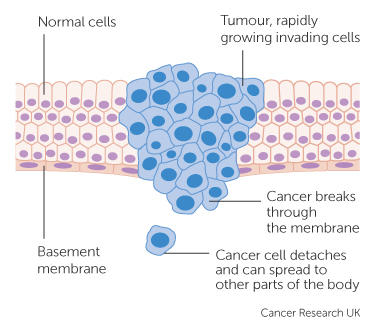
    "In order to spread, some cells from the primary cancer must break away, travel to another part of the body and start growing there. Cancer cells don't stick together as well as normal cells do. They may also produce substances that stimulate them to move. "

    a malignant tumour


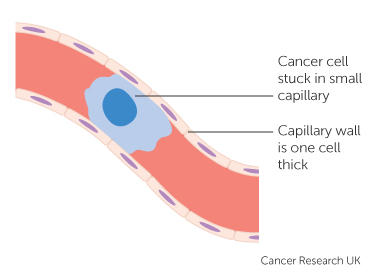
    "The circulating blood sweeps the cancer cells along until they get stuck somewhere. Usually they get stuck in a very small blood vessel called a capillary."

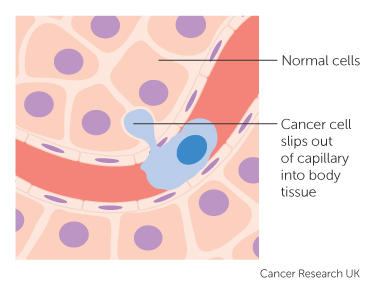
    "Then the cell must move through the wall of the capillary and into the tissue of the organ close by. The cell can multiply to form a new tumour if the conditions are right for it to grow and it has the nutrients that it needs."

    a cancer cell stuck in a small blood vessel capillary

    how cancer cells get into the bloodstream

    http://www.cancerresearchuk.org/about-cancer/what-is-cancer/how-cancer-can-spread


    Continue Reading
    "A healthy cell does not turn into a cancer cell overnight. Its behaviour gradually changes, a result of damage to between three and seven of the hundreds of genes that control cell growth, division and life span. First, the cell starts to grow and multiply. Over time, more changes may take place. The cell and its descendants may eventually become immortal, escape destruction by the body's defences, develop their own blood supply and invade the rest of body."

    "A cell is continuously receiving messages, both from its own genes and from other cells. Some tell it to grow and multiply, others tell it to stop growing and rest, or even to die. If there are enough 'grow' messages, the next stage of the cell's life starts. In a cancer cell, the messages to grow may be altered, or the messages to stop growing or to die may be missing. The cell then begins to grow uncontrollably and divide too often."

    "Every time a normal cell divides, the ends of its chromosomes become shorter. Once they have worn down, the cell dies and is replaced. Cancer cells cheat this system - they retain their long chromosomes by continually adding bits back on. This process allows cancer cells to live forever. Cells from Henrietta Lacks, an American woman who was diagnosed with cervical cancer in 1951, are still growing. They are used in research laboratories all over the world, many years following her death."

    "Every time a healthy human cell divides, it copies all its genes, which are bundled up into 46 chromosomes. This process has several checkpoints to ensure that each new cell gets a near-perfect copy. But in a cancer cell, these checkpoints are often missing. The result is chaos: parts of chromosomes may be lost, rearranged or copied many times and the genes are more likely to acquire further mutations. Some of these may allow the cell to escape other checking and repair mechanisms."

    "All the cells in your body usually work together as a community. But if a cell acquires a gene mutation that makes it multiply when it should not, or helps it survive when other cells die, it has an advantage over the others. Eventually, the abnormal cells acquire mutations in more genes, causing uncontrolled growth. These abnormal cells have a competitive advantage over normal cells. This is like natural selection in evolution, where a species that produces more offspring has a better chance of survival."

    "In normal cells, gene damage is usually quickly repaired. If the damage is too severe, the cell is forced to die. An important protein called p53 checks for gene damage in normal cells, and kills them if the damage is too great to repair. However, in cancer cells these checking mechanisms are defective. Cancer cells often have an altered p53 protein, which does not work properly, allowing cancer cells to survive, despite their dangerously garbled genetic material."

    "Any cells that start to multiply too much or in the wrong place are either stopped from growing, or forced into suicide by the process of apoptosis. In cancer cells, these instructions are either missing, altered or ignored. So cancer cells escape destruction, and continue to multiply in an uncontrolled way."


    http://www.sciencemuseum.org.uk/whoami/findoutmore/yourbody/whatiscancer/whathappensincancer/howdohealthycellsbecomecancerous

    Continue Reading
    Continue Reading


    Billy's Balloon (1998) is an animated comedic short film created by Don Hertzfeldt. The beginning of the animation just shows Billy holding a balloon in one hand while occasionally shaking a rattle which lasts just long enough (40 seconds) for the viewer to build up a sense of uneasiness and begin to question what they're watching. After these 40 seconds, it becomes very apparent what is being shown; a child being repeatedly beaten by a balloon.

    The film gets progressively more aggressive and over-the-top as more children being beaten by balloons come into frame, whether they're stuck on the floor with multiple balloons smacking into them or being lifted into the sky to be dropped to their deaths.

    The suddenness of the balloons aggression is amusing and catches the viewer off-guard which makes for a very interesting and well-designed introduction to the short. On paper, it could seem as though the film would get repetitious and boring but, because of well-timed cuts and progression in action, this just doesn't seem to happen.


    The main subjects of this short are definitely the balloons which is evident in the fact that they're the only thing with colour in the scene which causes you to wonder why. Why did Hertzfeldt decided to animate balloons beating up children? Why have the balloons be the focus instead of the children? Is it just some mindless fun or did Hertzfeldt intend this to be some kind of message? This film is just one big question.

    Bibliography:
    https://www.youtube.com/watch?v=Fpc5vgi9zbM
    https://www.flickr.com/photos/kungfukillah/5165947123
    Continue Reading

    Lotte Reiniger, born in 1899 in Charlottenburg, Germany, was a film director and, most notably, a silhouette animator. She is commonly considered a pioneer of silhouette animation and a "standard-bearer for women in the industry" (Hutchinson, P. 2016). During her younger years, she was inspired by the works of Georges Melies and Paul Wegener as well as Chinese shadow puppets.

    As she grey older, Reiniger became keen on working with Wegener, eventually becoming a silhouette designer for the intertitles in his films, her first being 'The Pied Piper of Hamelin' (1918). Reiniger was soon after given the task of animating rats which she enjoyed greatly, setting her future in the animation industry in motion.

    Lotte Reiniger went on to create almost seventy films, including a feature-length film: 'The Adventures of Prince Achmed' (1926).


    Bibliography:

    Quotations-

    Hutchinson, P. 2016, Lotte Reiniger, The Guardian:
    https://www.theguardian.com/film/2016/jun/02/lotte-reiniger-the-pioneer-of-silhouette-animation-google-doodle

    Images-
    http://animationresources.org/category/lotte-reiniger/
    http://www.awn.com/news/google-celebrates-lotte-reiniger-new-doodle

    Continue Reading
    Squash and Stretch:
    Squashing and stretching an object or character in animation helps give the illusion of weight and mass, aiding a lot in movement and facial animations.
    Anticipation:
    This is the anticipation of an action. For example, for a punch, a character would have a build-up of twisting their body and pulling back their torso and arm before the major action. This principle applies to all movements in animation.

    Staging:
    This pertains to the animation scene as a whole. Cameras must be well-placed to achieve a certain effect, characters must be clear in their expressions so as not to confuse the viewer, the background should not be competing for attention with the foreground elements, etc.

    Straight Ahead and Pose-to-Pose Animation:
    These are two very different ways of animating. 'Straight Ahead' means that the animator will first draw the beginning of a sequence and will work to the end of the scene straight from there which can result in some mistakes but has a spontaneity that 'pose-to-pose' doesn't. Whereas 'Pose-to-Pose' is when a lead animator will draw key frames throughout a sequence and then sending it off to someone else to fill in the blanks. This results in a much more neat and controlled animation.

    Follow-Through and Overlapping Action:
    Both of these refer to the continued movement of things attached to the main body of a character after movement or a change of direction. 'Follow-through' is the continued movement of hair, limbs, and clothing once a character has fully come to a stop whereas 'overlapping action' is when these same things continue moving in the original direction for a short while after a character suddenly changes direction.

    Slow-Out and Slow-In:
    This is the use of more frames of animation before and after an action. This causes action to seem to slower at the beginning and end, resulting in something far more realistic and believable.

    Arcs:
    The majority of animated characters and objects (with robotics and machinery being an exception) follow a curve as opposed to a straight, direct line.

    Secondary Action:
    An action used to compliment another, reinforcing a certain feeling or emotion in a character.

    Timing:
    The use of frames as a means to determine how long an action will be on-screen and how fast the particular animation should last.

    Exaggeration:
    This is a technique commonly used in very cartoony animations. It takes a movement and greatly exaggerates every part of it to make it clearer for the viewer as well as giving the sequence more appeal.

    Solid Drawing:
    The principle of creating weight, form and a sense of a third dimension within a 2D drawing.

    Appeal:
    It doesn't matter if a character is good or evil, it has to have some kind of appeal to help capture the audiences interest.
    Continue Reading
    Continue Reading

    Continue Reading

    Continue Reading

    A thorough list of some of Italo Calvino's cities from his novel 'Invisible Cities' and my thought/takes on each one.
    Continue Reading

    Here, I have highlighted areas of the text that explicitly give information to the appearance of the various cities described by Italo Calvino or their inhabitants. This will hopefully help with discerning useful text from the text that doesn't give any important information from an artistic standpoint.

    If you see anything that you think would be useful for me to take note of but I haven't already highlighted, please let me know.
    Continue Reading
    Older
    Stories

    recent posts

    Most Popular

    • Minor | The Woods - Giant Body Changes
    • Minor | The Woods - Developed Giant Head Variants

    Labels

    @Alan @Phil 12 Principles of Animation 1927 1933 3-Panel Comic Adobe After Effects Animatic Animation Animation and Character Arena Arnold Art Of Article artist research Artist Toolkit Audition Autodesk Autodesk Maya Backgrounds Backplates Batch Rendering Beate Kuhn Block Blog CG Workshop Character Character Design Collaboration Common Shaders Concept Art Cone of Cogency Creature Crit Das demo Digital Art Digital Painting Digital Sculpting Digital Set Displacement Dissertation Drawing Egg Cups Environment Concepts Ernest Schoedsack Establishing Shot Ethel and Ernest Exercise Expression Sheet Fantastic Voyage Fantasy Film Review Final Final Animation Final Audio Final Image Fritz Lang From Script to Screen Giant GIF Greenlight Review Group Head Heroine's Journey Humanoid Ideas Ident Illustrator Image 1 Image 2 Influence Influence Map Inspiration Interim Critique Interior Establishing Shot Invisible Cities Isolation King Kong Life Drawing Lighting Like For Like List Logline Low-Angle Shot Magazine Article Major Making Of Map Maps Mary and Max Maya Maya Tutorial Merian Cooper Metropolis Minor Model Modeling Monster Moom Mudbox OGR Online Greenlight Review Orthographs Painting Paprika Personal Work Perspectives Photoshop Pipeline 1 Pitch Playblast Posing Practice Pre-Production Pre-Viz Premise Premise Film Review Presentation Prey 2 ProCreate Production Bible Production Designer Production Schedule Progress Proof of Concept Proposal Ray Gun Reflective Statement Render Research Rig Rigging Run Cycle Script Sculpting Shaders Sketch Sound Design Sound Designer Profile Soundscapes Space and Environment Step Outline Still Life Story and Commission Storyboard Submission Submission Inventory Submission List Test Testimonial Texturing The Cabinet of Dr Caligari The Woods Thesis Thumbnails Title Toolkit 2 Toolkit After Effects Toolkit Animation Toolkit Digital Sculpting Toolkit Drawing Toolkit Maya Toolkit Sculpting Torso Travelogue Turnaround Turnarounds Tutorial Uncontrollable UV UV Layout Video Embedding Walk Cycle Watercolour Weapons What If Metropolis Wireframe Year One Year Three Year Two

    Created with by BeautyTemplates | Distributed By Gooyaabi Templates

    Back to top